 |
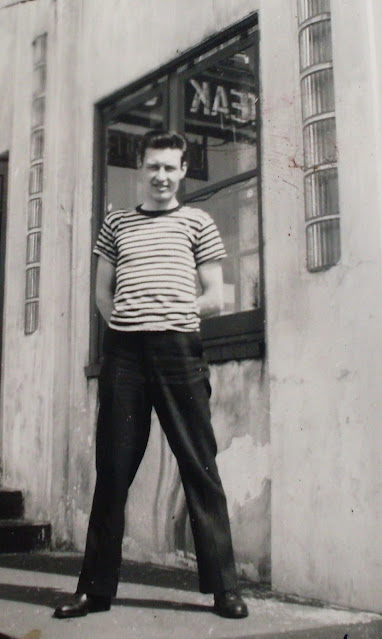
| Walter Kowinski 1944 |
According to Walter Kowinski and his brother William C.
Kowinski, their family in America began with their grandfather, John Kowinsky.
At least he was known to them as John Kowinsky, and their
father calls him that in his 1942 draft registration, in naming him next of
kin. But there are various spellings in
a trail of documents—not too unusual in reference to immigrants with long
names, especially when customs agents and even hurried Census workers were less than
sympathetic. There’s also the problem
of translating names from another language.
But judging by facts and relationships in common, he is
probably the “John Kowicusky” in the 1920 Census, “John Korvensky” in the 1930
Census, and John Kowensk (or John Kowensky) in the 1940 Census. He is even John Kowinski in an Ohio marriage
record, and John Kolacinski on his death certificate.
In these records, various facts—including birth date and
year of immigration—also change slightly.
But based on extensive cross-referencing, supported by facts recollected
by his grandson, William C. Kowinski, this is the best profile I can construct:
He probably came to America, recorded as John Kolacinski, in
the late 1880s, though I could find no record of his entry. This is not unusual, as New York immigration records from the 1850s to 1897 were destroyed in a massive fire at the Ellis Island facility. Many Polish
immigrants of this era docked in Baltimore, and some of those records also haven’t
survived. He may have been born as
early at 1863 but at the time of his death his family settled on the date June
17, 1870. So he was perhaps 18 when he
arrived.
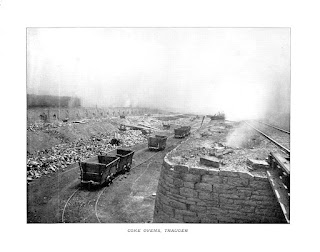
He may have gone directly to the coal mines and coke ovens
of Scottdale, Pennsylvania. He may even
have been recruited, as so many eastern Europeans were in the late 19th
century. American industries advertised for workers in Poland, and paid their
fare to the U.S. Western Pennsylvania
was a major destination. Pennsylvania
as a whole had a higher number of Polish immigrant coal miners than any other
state.
 |
| Frick Coal & Coke workers and families in Scottdale 1890 |
In any case, he was in Scottdale by 1891, for the birth of
his first child, John Joseph Kowinsky on May 12. (He was probably calling himself John Kowinsky by then.) He was working in the coke-making process in
1920, so he may have started here. Scottdale at that time was headquarters for
the H.C. Frick Coke Company. Coke was a
prime substance used in manufacturing steel, made by heating bituminous coal in
very hot ovens. The process was
pioneered in Fayette County, and the western Pennsylvania coal fields produced
the most coke in the world, beginning in the late 19
th century.
 |
| Mammoth Memorial in Mt. Pleasant PA |
John may well have been in Scottdale when an explosion in
the nearby Mammoth mines in 1891 killed more than a hundred miners, mostly
Polish, Hungarian and Italian immigrants.
It was one of the worst mining accidents in American history. Mammoth
also included coke ovens, though not yet owned by Frick.
In March 1894, his daughter Anna (also called Anna Stacia or
Anastasia) Kowinsky was born. Her
birthplace was either Scottdale or the nearby town of Everson, or in the Frick
coal and coke company town of Mutual, Pa.
Her mother was Madeline Vishnovsky, listed as John Kowinsky’s spouse.
John’s son, Frank Edward Kowinsky, was born on May 4,
1899—he would become Walter (and William C.) Kowinski’s father. I could find no direct evidence of the name
of Frank’s mother.
William C.—my Uncle Bill-- believes his grandfather John was
married twice. At some point he married
a woman named Josephine (she is attributed several last names, including
Vozniak and Lujack) and with her he had at least two children: Agnes Louise in
1905 and Marie Elizabeth in 1906.
(Josephine’s name of Lujack may explain the family
connection my father was told we had to Johnny Lujack, the star quarterback for
Notre Dame and the Chicago Bears in the 1940s and 50s, and later a sports
announcer. He grew up in Connellsville, PA.)
The history of John Kowinsky's fatherhood gets more
complicated, however. In 1891, in addition to John Joseph Kowinsky (born in May), he is recorded as the father of Frank Godzinsky (or Gedzinsky), born in August. He is father to Anna (born March 1894) and Victoria (November 1894.) Then he is the father to Rose Gedzinsky in 1896.
So either he fathered several of these children by different mothers in the same year, or there are adoptions involved, possibly of the offspring of other family members still in Eastern Europe.
There is some circumstantial evidence for adoption, at least of Frank Alex Godzinsky, who on several forms claims to have been born in Poland
(or Russia) and to have arrived in America in 1892. One document names his
father as Joseph Godzinsky. But at
other times he is said to have been born in the U.S. Most forms name August 26,
1891 as his birth date. In any case, John Kowinsky evidently claimed him as a
son, and in the newspaper death notice of Frank Godzinsky in 1965, John’s other
surviving children were listed as his sisters and brothers. The same was true of Victoria's obituary; her married name was Rosky.
However, William C. believes that Rose Gedenski-- born in August 1896
in Connellsville--was John’s daughter, and his father Frank Kowinsky’s
half-sister.
John’s 1920 Census form states he was a coke drawer (the
person who draws the coke out of the ovens) at the Frick Coke Company’s coke
works in United, Pa., and lived in rented company housing. He is a naturalized U.S. citizen, able to
read and write. His native tongue is
Polish. By this time, he is married to
Josephine.
By the 1930 Census he is in his 60s and essentially retired,
living with his wife in the household of his son-in-law Mike Kochis, and
daughter Marie. They had married in
1910. (Rose married Mike’s brother, Steve Kochis, a miner.) The Mike Kochis home was in United,
Pennsylvania, a coal patch company town near Mt. Pleasant. John and Josephine
are still in the Kochis home in 1940.
Their census form adds that John can speak English and that he had a
partial elementary school education.
John Kowinsky died at home in United in January 1949,
leaving 26 grandchildren and 19 great grandchildren, of which I am one. His death certificate called him John
Kolacinski, age 79. He had been a member of the nearby St. Stanislaus Catholic
Church; his funeral Mass was held there, and he was buried in the church
cemetery. His wife Josephine had died
in 1941.
But where was John born?
As our Severini family came from Manoppello, where did our Kowinski
family come from?
John spoke Polish, and on most forms, Poland is designated
as his birthplace. But where in
Poland? The question is complicated by
the fact that in the late 19th century, in the midst of large-scale
immigration to the U.S., there was no actual nation of Poland anymore. Its lands had been divided by more powerful
nations and empires, namely Austria, Prussia and Germany. Eventually some of
Poland was absorbed by Russia as well. Even when Poland became a country again, borders kept changing, so
that cities and towns could have been within different countries at different
times.
Many Poles who fled to North America in these decades came
from the region of Galacia in the Austrian partition of what is now southern
Poland, where poverty and oppression were particularly severe. An estimated 800,000 Poles from this region
came to the United States. (U.S. Census
records show a different John Kowinski, who emigrated in 1913 from Galicia, and
was a laborer in the Chicago stock yards.)
But the few clues in available records point in a different
direction. John’s birthplace in the
1920 Census is named as “Germany, Poland.”
John gave that same answer to the birthplaces of his parents (elsewhere
he indicates that his father’s name was also John.) Several of his children provide that same combination of
Germany/Poland when asked about their father’s origins.
The German Empire in the late 19th century
included East Prussia in northern Poland, with its Polish population. The German Empire also encompassed the
Prussian Province of Silesia in southern Poland, which had been (and is again)
part of Poland. German-controlled Silesia produced the earliest mass
emigration. Prussia had gone to war
with France, and the Poles supported the French. In retaliation, Prussia began “Germanization” of the region. Poles were being deliberately driven out,
while there was widespread poverty and starvation among the Polish peasants.
Large-scale emigration from Silesia began in the 1870s.
 |
| Darker area is Silesia in today's Poland |
Silesia also is notable for its coal industry, first
exploited by the German occupiers. The
oppression continued and even worsened in the region’s later history. Polish Silesia was the first area entered by
Nazi German troops that began World War II, and it was where the Nazis began
their program of genocide, targeting Jews and ethnic Poles, all of whom they
considered inferior.
There are a few other tantalizing clues that suggest either
Silesia or East Prussia as the origin point. One is the inclusion on John’s
1920 Census form of “Johan Kawiecki” as an alternate name. The name Johann Kawicki turns up as a
resident of the “Eastern Prussian Province, Germany (Poland.)” There may be no direct connection, but it is
suggestive.
Then there’s John’s daughter, Anna (Anna Stacia, Anastacia)
Kowinsky, who filled out a Social Security form (when she was married to Andy
Sulkowsky after 1911) using the name “Annastacia Cowiinsky.” It could be a misspelling, but the Ancestry robot
brings up another name: Casmira
Anastasia Cywinski, of East Prussia.
That in turn could be a coincidence, but if Anastasia is an old family
name—and first names tend to get repeated within families through these
years—it could suggest another possible origin point, especially as Anna was
John’s eldest daughter, perhaps with more knowledge of family history.
These speculations don’t narrow things down very much,
especially since East Prussia in the north (with its ports and cities) and
Silesia in the south of Poland are very different kinds of places. In historical terms, Silesia seems the more
likely origin point, but there may be more to be discovered.
Regardless of where the Polish ancestors came from, the family that came to be known as Kowinski
began in America in the coal mining communities of western Pennsylvania. This was true for John Kowinsky’s
generation, as it would be for the generation of his son, Frank Edward
Kowinsky.
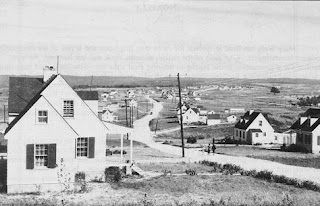
Many of these mining towns were within what’s called the
Connellsville Coal Field in Westmoreland County. These were “coal patch” towns, worker housing built and owned by
the coal company.
Coal mining was a
brutal occupation, and depended on the vagaries of production, price and
demand. Mines could suddenly cut back
or close for a period, and miners were forced to move on to another mine to
work. Eventually mines and coke ovens
would close permanently (beginning as early as the 1920s), and that town would
lose its major source of livelihood. So
it was not unusual for miners to move from town to town.
According to William C. Kowinski, his father Frank was born
in the coal and coke town of Tarrs, Pennsylvania, an unincorporated coal mining
and coke- producing town near Mt. Pleasant in Westmoreland County. On his 1942 draft registration, Frank named
another coal patch—Mutual, Pa.—as his birthplace. He also gave his birth year as 1900 (and in the 1940 Census, as
around 1901), but on his death certificate, his birth date reads May 2, 1899.
 |
| Humphreys |
For both the 1930 and 1940 Census, Frank named his
occupation as miner. In his 1942 draft
registration he wrote that he was employed by the Humphreys Coal and Coke
Company. His older brother, John Joseph
Kowinsky, also worked at the Humphreys mine, and lived in the mining town of
Marguerite.
Back in 1920, on December 29, Frank Kowinsky had married
Catherine Cecilia Ellis ( her name was sometimes spelled Katharine or
Kathyrn.) She was Walter’s mother, and
the mother of his siblings. Thanks to
the research compiled by William W. Smith (an Ellis descendant), a little more
is known about Catherine’s prior family than is known about her husband’s.
Catherine’s father was John Illas, born in 1867 somewhere in
the Austria-Hungary empire. He married
a woman from Romania named Mary Tkracz in 1891. (The Tkracz family name “can be
traced back many centuries,” Smith wrote, “to its origin in the city of L’vov,
in Western Ukraine.” The Illas name is
more elusive, but it may be a variation of other Slovak or Hungarian names.)
According to a granddaughter, John Illas could speak Hungarian, Slovak and
Polish, at least well enough to teach her to count in each language.
John Illas arrived in America through the port of Baltimore
in 1893, probably on a ship from a German port. He also may have been
approached by a coal company recruiter, either in Europe or upon arrival. In any case, he soon began work at a Hecla
mine in Trauger, which is in Mt Pleasant Township, Pennsylvania. The Hecla
mines were operated by the Thaw and Dorsey Coal and Coke Company until 1906,
when they were taken over by the H.C. Frick Coal and Coke Company.
By 1896, he had made
enough money to send for his wife and two children, John and Christine. Their
subsequent four children were born in the US, including Catherine Cecilia, who
was born in Trauger on March 21, 1902.
By this time the family had changed its name to Ellis.
(This would not be the last time John Illas/Ellis changed
his name. After his wife Mary died in
1928, John answered an advertisement for a handyman at a Michigan farm, and
started a new life, complete with a new name.
In 1930 he married the daughter of the farm’s owner, Johanna Kutney,
using the name of John Aller. His last
child, Antonia, was born in 1931, when he was 64. He died three years later, as John Aller.)
But in 1918, John
Ellis was working at the nearby Calumet mine. The family was listed in the 1920
census as living in the United District of Mt. Pleasant Township. The Calumet
and United, PA mines were working in conjunction.
Though coal and coke dominated this landscape, the area also
had an earlier history. Indian paths crisscrossed Pennsylvania by the 1700s,
and the town of Mt. Pleasant grew at the crossroads of two of them: Glades Path
(which later became Route 31) and Nemacolin’s Path (widened and extended by the
Delaware Nation chief Nemacolin and then used by British General Braddock to
build the Braddock Road during the French and Indian War of 1755.) This early history is probably reflected in
the name of Calumet, which is a French word that came to denote the Indian
peace pipe.
This also was the area visited by the preeminent geologist
Charles Lyle from England in 1826 to examine fossils found on a farm near
Marguerite, proving that air-breathing reptiles had existed much earlier than
previously believed.
Frank and Catherine’s 1920 marriage was officially
registered in Cumberland, Maryland.
Walter, their first child, was born on December 10, 1921 in Boswell, PA,
a coal town in Somerset County, now part of the Johnstown metropolitan area. His official name was given as Walter Xavier
Kowinski. He was baptized at St.
Stanislaus church in Boswell as Ladislaus Kowinski on December 18 by Rev. W.
Finke, with J. Kridasik and Elizabeth Dedyk listed as sponsors. “Laudislaus” is
a Slavic name, used in Hungary, Poland and Austria, for example.
Walter’s birth and baptism in Boswell suggests the family
was living there at the time, and the nature of the town suggests that Frank
Kowinsky was employed there. The mine
at Boswell, Orenda Mine #1, was large and productive at the time. In 1920, it had the largest coal tipple (a
structure used to load coal onto railroad cars) in the world.
Frank Kowinsky, his
wife and son were likely in Boswell during the coal strikes of 1922. With harsh conditions, long hours, bad pay,
no benefits, and miners forced to rent company housing and buy from the company
store, unionization and strikes had previously occurred in separate mining
areas throughout in the country since the late 19th century.
The Westmoreland County coal strike of 1910-1911—also known
as the Slovak Strike because more than two-thirds of the miners were
Slovak—involved 65 mines and 15,000 coal miners. As would happen again, mine owners used private police and thugs
as well as the state and local police and courts to break the strike, which
they did, with defeat for the miners. Sixteen miners or members of their family
were killed.
The miners were more successful when the United Mine Workers
called a national strike in 1919, in which approximately 100,000 Pennsylvania
miners participated. The strike
resulted in a 14% wage increase for miners.
When owners threatened to reduce wages in 1922, United Mine
Workers called for strikes by union members on April 1. Non-union mines continued to operate, but
miners in Jerome in Somerset County also went on strike, to unionize. This strike spread to Boswell on April 17,
and lasted for 16 months.
 |
| strikers in Scranton PA 1922 |
Meanwhile, John Illas/Ellis was working in the Hecla Number
3 mine, apparently a union mine when the United Mine Workers 1922 strike was
called. William Smith interviewed
members of Catherine Ellis’ family who recalled this strike, or heard stories
from their parents. When the strike began,
miners families—including theirs—were evicted from their company-owned homes. The union supplied tents and some financial
support. They subsisted on garden
vegetables, soup and noodles. When
winter came and the tents were too cold, the Ellis family moved into an
abandoned pool room, which they shared with another family.
Violence also accompanied this strike. Company towns were considered private
property, and company police prevented residents from leaving, and screened
others who wanted to get in. The union
settled in the spring, but this only prevented wages from being cut.
In that spring of 1923, John Ellis found work at the Calumet
mine, and the family moved there. Also
in 1923, the Frank Kowinsky family moved to United, PA, another coal patch town in Mt. Pleasant
Township near the Calumet mine. The
United mine had been opened and the worker housing and general store built by
the United Coal and Coke Company, formed by a group of Greensburg businessmen
in 1881. By 1895, the H.C. Frick
company had taken control of the operations at United, as it did in Calumet and
elsewhere in the Connellsville Coalfield.
Walter grew up in United.
Also in 1923, Frank and Catherine Kowinsky had their second
child, son Frank Edward Kowinski Jr., born in United. He became known there by the nickname “Bugs.” Their third son,
William Charles Kowinski, was born in United in 1925, and their fourth child
and only daughter, Beatrice, was born in 1928.
They all grew up in United.
The 1930 U.S. Census lists Frank Kowinsky as a coal miner,
living in a rented house with his wife (listed as Kathyrn) and four children:
Walter, Frank, William and Beatrice.
 |
| Post Office at United, PA 1935 |
The Depression years of the 1930s were particularly harsh in
the coal patches of western PA. A study
by the American Friends Service Committee estimated that in “mining counties”
of Pennsylvania, almost everyone suffered from malnutrition--nearly 90%. The hardships were compounded by many of the
Connellsville Coalfields mines closing in the years just before and during the
Depression (Hecla mines in 1925, United in 1930 and the Calumet mines in the
early 1930s.)
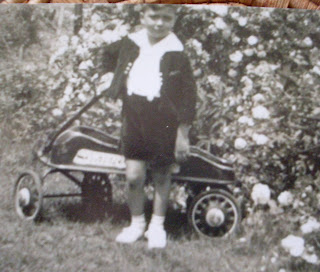
I know of only one aspect of Walter’s childhood: he built a
crystal radio set using an old cigar box, although this might have been later,
when he was a young man. Building
radios and otherwise tinkering with electronics remained a keen interest for
much of his life. (The 1930 Census asked whether the household had a radio, and
the answer was yes.)
 |
| Walt is top row, second from left |
Walter Kowinsky became one of 222 first year students at
Hurst High School in September 1935. He
is pictured with the 1936-37 sophomore class in the 1937 Colophon
yearbook. This makes it likely that he
graduated in 1939, the first in his family to finish high school.
Shortly after that, Walt joined the Civil Conservation
Corps, the CCCs: one of the first of FDR’s New Deal programs, eventually
sending hundreds of thousands of young men (and some young women) to work in
forests and parks, and on projects to stop soil erosion and prevent
floods. As governor of New York,
President Roosevelt had instituted a similar but smaller-scaled program, and
the federal program appears to have been his own idea.
The first CCC camps opened in the spring of 1933. They were
supervised by the Labor Department, but because of the need to organize and
equip them in a short time, they were run by the U.S. Army. Eventually there were some 300,000 CCC
workers each year, for a total over 9 years of some three million participants
in some 4,000 camps.
Single young men between the ages of 18 and 25 (later
expanded to 17-28) were eligible to be selected. (Later there were provisions
for women, and as customary at the time, separate camps for Black members. Contrary to some war movies, the U.S. Armed
Forces were also segregated throughout World War II.) Each member was provided with free food, clothing, shelter and
medical care, and a monthly wage, most of which was sent home to their
families. Members served six month
terms, and could re-enroll for up to a total of two years.
Walt’s CCC unit worked in the Big Spring state park in
central Pennsylvania, but it’s not clear how much he participated in the
outdoor toil. His 1940 Census form
notes that his area of occupation is “reforestation,” but his job is “clerk.”
 |
| Walt at his CCC camp 1940 |
Three surviving letters to Walter at his camp—two from his
mother in United, one from a buddy in another CCC camp in the Laurel
Highlands—tell us that he was near the end of a term in the spring of
1940. He was posted near Blain in Perry
County, central Pennsylvania. His camp
was designated as Company1382 S-111. This CCC camp of 200 young men (known as Sundy Place and also as Camp Lorenzo Pryor) opened in
1933, and closed in July 1941.
Like other CCC camps, S-111 had its own baseball and
basketball teams that played teams from other camps or local communities. There was a camp newspaper. Typically CCC camps offered an array of
classes and instruction, ranging from basic literacy and math skills to
forestry, bookkeeping and mechanical drafting.
Social skills and job-hunting skills were also taught.
Walter’s friend, evidently from United, was at Kooser Camp,
S-99 in Somerset, PA. His letter was
mostly about young women he met and dated in Somerset, where he was careful to
appear only in “civilian” clothes as there evidently some prejudice against CCC
members. “You know ‘woodpeckers’ don’t rate in Somerset,” he wrote. He mentions that his camp was hosting
monthly dances, and that the camp had a lot of visitors, some to use their
recreation hall. He asks Walt if there
had been forest fires in his area. He said they had six in one day, and he was
one of the camp’s volunteers to fight one of them.
Judging from his mother’s first letter in April, Walt was
due to come home for a six day leave, and had to decide if he was remaining in
Blain for the summer. His father said they would miss the money, which they
were saving. He was working (evidently at the Humphreys mine), but there were layoffs because of “dirty coal.” “He’s so proud of you,” she wrote.
 |
| Big Spring State Park |
The second letter in May suggests Walt had made up his mind
and was returning. (The letter also
says Walt’s father Frank was celebrating his 40
th birthday on May 4,
which would make his year of birth 1900 rather than 1899.)
Catherine’s affectionate letters had news of people they
knew in United. She mentions a “Crolick
boy,” evidently also in the CCCs, who came home and visited the Humphreys mine
in Unity Township, which was one of the few still operating (it closed in
1946.) She writes that her husband
Frank saw him there.
She also passes along the address of “Uncle Steve” Ellis
(her brother) in Holidays Cove, West Virginia.
But much of the news in her letters is about housing.
Evidently the homes in United owned by the company were being sold. She names those buying their own house or
the house of neighbors. She worries
that they may have to move out if someone buys their house.
There are also references to “daddy’s dad”—John Kowinsky--
buying his house, though this is likely the house of his son-in-law Mike
Kochis, with whom he had been living since at least 1930. There’s also a reference to “Mother,” who
might have been John’s wife Josephine.
Catherine also mentions “the homestead” and the houses there
up for sale. This is the nearby New
Deal project originally called the Westmoreland Homestead. In 1934 the federal government bought up
about 1500 acres of farmland and built a small community of homes with attached land, a cooperative
dairy, a building for a small factory that made clothing, and farmland held in
common. Local families, usually with an unemployed head of household, applied
for one of these homes. Some 250 were accepted, broadly representing the
diversity of the area. They got a house
with a garden and chicken coop, and a job, often at the cooperative farm or
their garment factory.
In 1937, when Eleanor Roosevelt visited, this had become the
largest of 92 subsistence homesteads created by the New Deal. Mrs. Roosevelt was reputedly a strong
supporter who insisted that the homes include running water and indoor toilets,
which the nearby coal patch housing didn’t have. After her visit the community voted to name itself after her,
combining the last syllables of her first and last names to create Norvelt.
The homesteaders paid a small rent, and apparently beginning
in 1940 were given the opportunity to buy their homes. Eventually most of them did. The name of Norvelt still exists as an
official community for the U.S. Census, alongside its neighbor Calumet.
After federal support was withdrawn, the garment factory at
Norvelt continued in business for some years.
When it closed, other businesses moved into the building, including one
that employed Deborah Kowinski Boice, one of Frank Kowinsky’s granddaughters.
Had Frank Kowinsky unsuccessfully applied for a place in the
Westmoreland Homestead? This is another unanswered question. Eventually however, the family did buy their
house in United.
In the 1940 Census form, Frank listed his occupation as
“miner,” but he had worked only 13 weeks in 1939.
If Walter did leave the CCCs in 1940 when he was 19, he was
soon accepted into another but lesser-known New Deal program, a work experience
project under the National Youth Administration. Some 155,000 young men and
women got job training and paid work.
Walter was assigned to a project in South Charleston, West
Virginia called Armor City. The work
and training were evidently more for industrial jobs than work in the
woods. The name itself suggests that it
became work in national defense. At the
time, South Charleston had a large naval munitions plant, once visited by
President Roosevelt.
(Also living in Charleston at the time was his father’s
older sister, Anna. She was married to
Alex Squirts, and according to my Uncle Bill Kowinski, they ran the Edwards
Hotel there.)
A group photo shows Walt in an army-style uniform, with his
tie tucked into his shirt, similar to his CCC photo. Like the CCC camp, Armor
City had its own newspaper, the Armonian, but this time Walter Kowinski was its
editor.
One mimeographed and
stapled edition survived. It described Armor City as a “self-governing
community.” The
newspaper had news, sports and humor, with pen and ink illustrations and
cartoons. In the news was the fund
drive held by the Youth Government of Armor City to benefit the British War
Relief Society. They collected enough money to buy a hospital bed and all its
equipment, including blankets, water and instrument sterilizers, bedpans, wash
basins, ether blankets, towels and medicine glasses.
On
Flag Day in June 1941, the young people at Armor City heard a group of debaters
from nearby Marshall college hold a panel discussion on the topic, "Shall
We Enter the War?" Six months
later, they had an answer. Japanese forces attacked the American naval base at Pearl Harbor in Hawaii on December 7, destroying much of the Pacific fleet, and the US was shortly at war with the Axis powers of Japan, Germany and Italy.
Walter
registered for the draft in February of 1942.
By then he was living in Maryland, and working at the Middle River
Aircraft plant in Baltimore. He listed
Glenn Martin as his employer. Martin
began the plant and is famous as the founder of Martin Aviation. At the height of World War II, this aircraft
manufacturer had 53,000 employees.
Walt was called up at some point but failed the physical. The family story is it was because of color blindness. But he also may have had a spinal deformity related to a bad fall as an infant. After growing up in
the Depression, many young men failed the physical because of the effects of
malnutrition or lack of needed medical care--especially those from coal mining areas. Walt's brother Bugs also failed his physical.
Walt either inquired
about or unsuccessfully applied to join the Merchant Marines. The Merchant Marines were a vital component of the war effort, transporting cargo and passengers. Under the direction of the US Navy, their ships were a vital supply line, especially across the Atlantic and later the Pacific to war zones. Members of the Merchant Marines traveled on armed vessels, but Navy personnel manned the guns. It was a dangerous assignment aboard these ships, which were prime targets for German U-Boats and other enemy warships: Merchant Marines casualties had the highest rates of all US services during World War II. (Being denied because of color blindness is also a plausible reason for this service.)
Walter
was not alone in registering for the draft in early 1942: all American males
ages 18-64 were required to do so by an Act of Congress on December 19,1941. Walt’s
brother Bugs (Frank, Jr.) registered on June 30, 1942, when he was living in
Braddock, PA, and working at the Edgar Thompson works, a steel mill owned by
Carnegie Illinois Steel. Even Walter’s father Frank Kowinsky registered on
February 10 in United.
 |
Kowinski family in 1943. Top left 2nd row is Catherine Ellis Kowinsky. Squatting lower right in
white shirt is her husband Frank Kowinsky. Their son Walter Kowinski is sprawled at bottom. His
sister Beatty is directly down from Catherine, in a similar dress. Next to her with arms around
youngsters is their brother Bugs (Frank, Jr.). Others in the photo include Catherine's brother
Charles and sister Ann next to her, and Margerie Ellis. |
Walter was in Maryland in August 1943, when he was called home for the
funeral of his mother. She had received treatments at Pittsburgh Women's Hospital for cancer resulting from poor medical care during childbirth. Catherine Ellis Kowinsky died at home at the age of 41. I recall my Uncle
Bugs saying that it hit Walter
particularly hard. But it would be Bugs
who years later would fondly remember the aroma of his mother’s pies cooling in
the window.
Walt's brother Bill suggests that it was Walt as a young adult who began spelling his last name with an "i" at the end instead of a "y." His brothers then did the same. Bill didn't recall why, and when I had asked my father about the reason for this difference in spelling, his answer was vague and possibly evasive. But from then on, it was Kowinski.
 |
| Bill Kowinski, Seaman |
Earlier in 1943, Walter’s youngest brother Bill Kowinski finished his second year of
high school and joined the Navy in July, at the age of 17. Bill told me that since both of his older brothers were found medically unfit for the armed services, he felt it was up to him. He wanted to serve his country.
After basic training at Great Lakes Naval Training Station in Illinois and further training at Pearl Harbor, he joined the crew of 2700 aboard the battleship USS Pennsylvania in September 1943. The Pennsylvania was classified as a super-dreadnought battleship, built in the first decade of the 20th century. It was too advanced to see action in World War I (it ran on scarce diesel fuel instead of coal) and by the time World War II began, it was limited by older technology, particularly radar. But the Pennsylvania was used heavily to support troop landings, recon and other activities in the war in the Pacific with suppressing fire. It’s probably why, as Bill told me, this ship fired more rounds than any other in the history of war.
Walt wasn't the only Kowinski boy interested in radios. Bill had learned to fix radio sets, and on weekends in high school he made some extra cash repairing radios. When he passed on this information to his superiors in the Navy, they put him to work fixing radio equipment on the Pennsylvania.
Bill had barely a month to get used to the ship when the Pennsylvania began shelling Makin Atoll, where it was under fire from Japanese planes, and shaken by an explosion on a smaller vessel nearby. In January and February 1944, the Pennsylvania bombarded several of the Marshall Islands. After a memorable liberty in Australia in April, the ship began weeks of shelling various targets in Guam and other islands.
In October 1944, the Pennsylvania was tasked with providing covering fire for activities in preparation for the assault on Leyte in the Phillippines. It was there, in the Suriago Strait, that the Pennsylvania was present and tangentially involved (chiefly anti- aircraft) in one of the decisive naval battles of the war, where US forces defeated and mostly destroyed the remnants of the Imperial Japanese Navy.
The Pennsylvania returned to San Francisco in February for overhaul and training, probably preparing for the expected final assault on Japan itself, and didn’t leave again until July 1945. After bombarding Wake Island, the ship arrived at Okinawa on August 12, as the flagship of Task Force 95. Fighting had been going on for that island just 400 miles from Japan since April. However, by the time the Pennsylvania arrived, the first atomic bomb had destroyed the city of Hiroshima in Japan on August 6, and another atom bomb obliterated Nagasaki on August 8. Afterwards the US had communicated its terms for Japan’s surrender.
But the war was not officially over when a torpedo from a Japanese airplane ripped into the Pennsylvania at about 8 p.m. on its first night at Okinawa. The explosions awoke seaman Bill Kowinski, catching a few hours of sleep before his midnight watch. “From that moment on it was chaos,” he told a newspaper reporter in 2020. He followed his orders—“You just wanted to do what you could to save the ship.”
There was a huge hole in the ship’s side, but that area was sealed off (at the cost of 20 lives, including those killed in the explosion) and the ship survived. Three days later, the war was officially over, so the Pennsylvania became the last major ship to be damaged by enemy fire in World War II.
Temporary repairs began there and later in Guam, before the ship sailed for port in the state of Washington, USA. Meanwhile, a young communications officer was tasked with organizing the burial at sea of those who’d died. His name was Johnny Carson, known until then for doing magic tricks and telling jokes to entertain the crew. He was a funny guy, who claimed he once pranked an admiral.
Bill was honorably discharged in February 1946. That summer, the Pennsylvania was back in the Pacific (without him) as a floating guinea pig in the first postwar atomic bomb tests called Operation Crossroads, which began on the day I was born.
Other
members of both the extended Severini and Kowinski families were involved in
the war effort. For example, Jenny Romasco,
daughter of Gioconda’s sister Pearl, was a secretary for the Quartermaster
General at the Pentagon. And as factory
workers at Robershaw, Walter Kowinski and Flora Severini were doing war work.
It
was probably after his mother’s death in 1943 that Walter found a job at the
Robertshaw plant in Youngwood, and met the dark haired Italian girl who shared
her lunch with him.
 |
| Walter Kowinski and Flora Severini 1945 |