 |
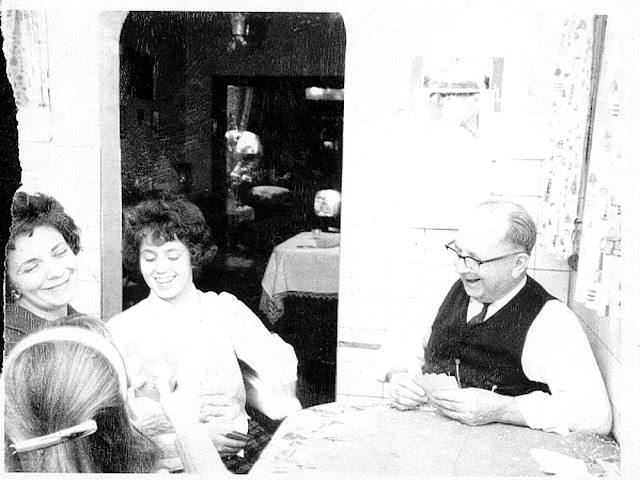
left to right: Debbie Kowinski (back of head), Flora Severini Kowinski, Kathy Kowinski,
Ignazio Severini, in the kitchen at 200 Depot St. I had to squeeze between the table and the
sink to get this candid shot. This surviving print is not great, but it's my favorite of all
the photos I've taken. |
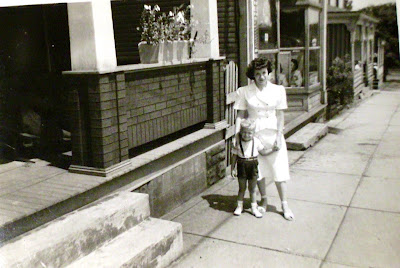
Conventional wisdom was that while members of some immigrant groups tended to marry outside their nationality (Poles, for instance), Italians in America were more likely to marry other Italians. But as it turned out, none of the children of Ignazio and Gioconda Severini married another Italian. Yet the family center for all three of these new families remained the Severini household, and for several decades its physical center was 200 Depot Street in Youngwood.
My grandparents’ house on Depot Street was covered with dark
red shingles meant to look like bricks.
The cement front porch was as wide as the front of the house, up two
steps. It was partially enclosed, and
there were white wooden columns on each side of the steps. On the far left of
the porch, a storm door opened to the heavy wooden front door, a beautiful
light brown, with a long oval of thick glass on the top half, a kind of art deco look.
Large standing pots of my grandmother’s ferns were nearby.
(Someone stole them off the porch in the 1980s, and sold them to a flower shop
up the street. My grandmother saw them there and told the owner, who eventually returned them.)
There were two
windows in the center of the front wall, and another heavy wooden door on the
far right, though it was blocked by more ferns on the inside, and never
used. This probably was once the
entrance to the store that likely took up what became the living room and
perhaps more of the first floor, before the Severini family rented and then
bought the house in the 1930s.
 |
| something like this 1950s porch glider |
In summer, on the right side of the front porch would sit a
metal porch glider, under a dark green cover when not in use. The cushions would be brought inside the
rest of the year. My grandfather would
replace the storm windows on the door with screens every Memorial Day, and
would exchange the screens for storm windows on Labor Day. Probably the glider cushions followed the
same annual schedule. There were also a
couple of green (or green and white) metal chairs, one of which was a rocker.
The front door opened on a hallway. To the immediate left as you came in was a
tall radiator with dark wood top.
Farther down the hall, also on the left, sat a small dark wood table and
very small matching chair, under a decorative mirror. It was the telephone table.
In those years, the phone was heavy and black, old-fashioned even in the
1950s. It was the only telephone in the
house.
 |
| me at the telephone table |
In the early 50s,
phone calls were made by picking up the receiver, waiting for an operator to
say, “Number, please?” and saying the number. Our home number was 3329-M.
Probably by the late 1950s, calls were dialed on the rotary
phone. My grandparents’ phone number
then was WAlker 5-2377. The Greensburg
area was a test for touchtone phones in the early 1960s, when the phone numbers became all numbers.
In the 50s, long distance calls were expensive and therefore
rare. But at Christmas when the
extended family in western PA was all there, we would gather around that phone
in the hall to exchange a few words with Aunt Toni and her family in
Maryland.
With the telephone table on your left, directly in front of
you were the carpeted stairs to the second floor. (Since this front door opened on a hall that led directly to the
stairs, with doors that could close off both the living room and dining room,
it was probably the entrance to the residence upstairs when the house hosted a
store.)
To your right facing the stairs was a door leading into the
living room. But if you took another step and a slightly angled right, the
dining room and the kitchen beyond it were ahead. Walking into the dining room, dominated by the big dining room
table, you could pass the brick fireplace on your right (blocked up and never
used in my time) and there was a large arched entrance to the living room, also
to your right.
I recall these rooms—the living room and dining room--
filled with Italian relatives and family friends when I was very young. I remember Mr. and Mrs. DePaul, Vince and
Mrs. DePasquale, Mrs. Gelfo with her enormous eyes behind thick glasses, Lena
Mari, and a pretty young relative named Angeline. There was a lot of talk and
laughter, often loud. It was exciting and also overwhelming.
Sometimes on our small family visits, my mother would go
across the street to visit with her old friend Ange—now Ange Miller—and maybe
“get her hair done.”
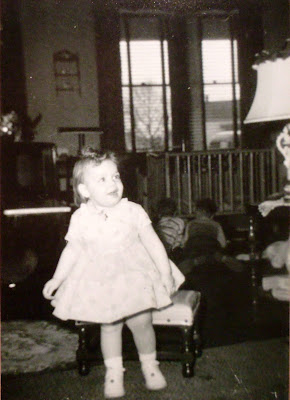 |
| Debbie in the living room. |
Perhaps it was at the house or perhaps elsewhere, but Carl remembered a game that the men played called “morra:” Two men would each throw down a hand
with any number of fingers extended while
shouting out another number--the number of
fingers they would throw down together.
The one who guessed the number right would win. It was a loud game and if two men were
evenly matched, others would watch and cheer and laugh. They would laugh especially if one man
called out
tre! and himself threw
down four fingers.
It was also in this living room that our grandparents,
particularly our grandmother, played with us as babies and toddlers. In particular, I remember my grandmother
bouncing my sister Debbie on her knees and singing “Rock Around the Clock” to
her.
The configuration of the living room changed somewhat over
the years, but this is how I remember it from the 1950s. Against the living
room wall on the other side of the fireplace along the same wall as the arched
entrance was an armchair, where my grandfather often sat.
Along the long wall
to your right as you faced the windows was the large couch, with a dark wood
coffee table in front of it. On it usually sat a cut glass candy bowl partly
colored red, which I now have. There was a small end table to the right, and I
believe this is where the floor lamp with the red shade was—the lamp I now have
in my library/den. In the far corner
was a larger, round dark wood table with a large lamp on it. It had a yellowish brown shade with faint
painting on it, that reminded me of the Sandman’s umbrella in the My Book House
books. My sister Kathy has this lamp
now.
 |
Since we lived just 6 miles away, my sisters and
I often had a second Christmas morning here,
under the tree where my grandfather's chair
in the living room usually was. In my early
years when we stayed over, it might be my
primary Christmas morning, as likely in this
photo of me in my "sleepers." When the
Wheatleys visited over Christmas, they also
had their morning presents here.
|
Looking straight ahead again from the dining room entrance,
on the wall opposite were two windows with Venetian blinds that looked out on
the front porch and Depot Street. Under
the windows was another long radiator with a wood top, and a potted plant or two
on it. To the left of the windows was a
polished wood desk and matching chair. On the top of the desk was a desk lamp and blotter. If you pressed down on a button on the base of the lamp, a florescent light flickered on with a distinct hiss.
The desk was kept very
neat and without anything on it. There
was a center drawer and three drawers on the left. As a child I had to ask
permission to sit at the desk, and had to show that I kept it neat. I occasionally did homework there or wrote
in one of my brown notebooks. It felt important
to sit at that desk.
In one of those desk drawers was kept the View- Master—and
again, looking at this required separate permission. The View-Master was a black viewer that looked a little like
binoculars. You inserted a round
disk—careful that it was seated properly—and looked through the two eye windows
to see a vaguely three-dimensional image. If I remember correctly, when you
pressed a button an internal light lit the image. You clicked a side lever to
change the image. The disks in the drawer as I recall were of cities and
landscapes. As mentioned, the
View-Master was introduced at the 1939 New York World’s Fair. This model was likely from the 1950s.
I didn’t usually sit
at the desk to read but there is one book I associate with reading at the desk:
an anthology of science fiction that I believe was my prize find of the books
stored in the attic. In particular I
remember a story about archeologists discovering evidence that humanity did not
start in Asia or the Middle East, as was believed at the time, but in Africa. Heretical and “science fiction” in the
1950s, it’s since become the standard view.
But I’ve never been able to track down this story since.
To the left of the
desk was the other outer door that wasn’t used. Large potted ferns stood directly in front of it. In front of them was the television set. For many years it was a polished piece of
dark wood furniture that sat on the floor, with two doors that were usually
closed, but that opened with a little click to reveal the television screen.
 |
When the piano was at the right wall. The
sandman lampshade on the table behind. |
Along the right wall, and then the left wall of the room was the big dark piano that Carl played, with
its piano bench. I used to play under
it, and sometimes watch my Uncle Carl’s hands on the keys, seated on the floor
or under the piano itself. I was
fascinated with the three gold pedals.
When I was in third grade, I saw sheet music for Irving
Berlin’s song “White Christmas” either on the piano or inside the bench. I read the words to the introduction, which
is almost never sung, that tells of being in warm and green Beverly Hills in
December, dreaming of a white Christmas.
The idea of a Christmas without snow—which seemed almost impossible to
me—caught my interest and nudged my imagination, so when my third grade teacher
told us to spend one class period writing a play, that was the basis for the
one I started, called “A Summer Christmas.”
I finished it at home, and the class later performed it.
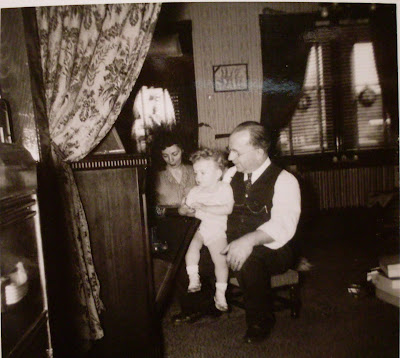 |
Flora, me and grandfather: the radio and record player. Note
the oval glass of the blocked door in the background. |
Facing the piano, to its left in a corner of the room was
the ornate mahogany radio and phonograph.
It was from the 1940s if not earlier.
I remember hearing some of the last radio shows there, sitting on a
covered stool in front of it. I
listened to “Fibber McGee and Molly” once because it was a favorite of my
mother’s, but I didn’t understand much of the humor. I was fascinated with “Baby Schnooks” and would ask if it was on,
and I listened to “The Lone Ranger,” and Jack Benny and other programs, but I
only remember listening to them in Youngwood, and on that radio.
The radio program I remember most was broadcast every
evening at seven o’clock, when my grandmother would come in from the kitchen
and sit on the stool in front of the radio or in my grandfather’s chair, with
her rosary beads. A small red votive
candle would be lit. On the radio, the
same priest would say the entire rosary for the next fifteen minutes, and a
chorus of churchgoers would respond. I
was fascinated with the odd way the priest said “Jee-sus,” and how his voice
was always the same. (I hadn’t yet
grasped the concept of a recording.)
But mostly it was hard to stay still and quiet for fifteen minutes.
The 1950s happened to mark the apex of Italian culture in
America. In many ways it seemed it
was
American culture. Many of the most
famous entertainers—especially singers—were Italian-American, from Frank
Sinatra and Jimmy Durante to Perry Como (who was from the Pittsburgh area, and whose parents came over from the Abruzzi in 1910.) On one end of the cultural spectrum,
Italian opera singers were popular and some, like Ezio Pinza, sang in musicals
and on television. On the other end,
Lou Monte had a string of comic hits partly in Italian, and in 1953 Julius La
Rosa had a hit with a novelty song sung completely in Italian, “Eh,
Cumpari!” In 1958 an actual Italian
singer had an all-Italian love song hit, re-recorded as “Volare.” Even Rosemary
Clooney flirted with Italian dialect.
Joe DiMaggio was the
most famous baseball star, and players with Italian names were prominent on
many sports teams. Pizza and spaghetti
and meatballs were taking their place on the American menu alongside hamburgers
and fries. So this living room felt
comfortably like the center of the world for many reasons.
(There were even Italian American comedians, and Italian references in jokes. One joke from a TV variety show that I committed to memory was a brief parody of the song "O Solo Mio." The comic sang: "O solo mio/ O solo you-o/ Who put the chlorophyll/ in my pasta fazool-a.")
If you’re looking at the radio, it’s just a couple of steps
to your left until you’re in the dining room again. The wall that separates the rest of the dining room from the
living room holds the dark brick fireplace, and a dark wood clock above it on
the mantle piece.
Looking towards the
back of the house to your right, there’s a large mahogany sort of bureau along
that wall—I expect there’s an actual name for this—with a lot of surface and
lots of drawers. The top drawers held odds and ends, including old eyeglasses,
as well as cloth napkins. Probably the good silverware was kept here. The long
lower drawers contained tablecloths and so on.
Among the objects
on top was a large embroidered doily (there are lots of doilies everywhere,
probably all made by my grandmother) and two delicately fluted kerosene
lamps. They still were actual gas lamps
within my memory, but at some point my grandfather wired them for electric
light bulbs.
Much of the furniture in this room as well as others could probably be classified as influenced by Art Deco, popular in Italy between the wars, and even some in the lo stile floreale style, the Italian version of Art Nouveau, from an earlier era.
 |
Dining room on my third birthday 1949. Baby in
high chair is Mary Jane Butina. |
In the far corner near the kitchen on that side of the room
was a matching cabinet, though taller. Behind two glass doors in the upper part
were dishes and so on. Also in there
was a small silver dinner bell, which I got to ring at dinnertime. Below were solid wood doors, behind which
were various items, including the
anisetta and other spirits. There was another cabinet of darker wood at
right angles next to it, not as tall, with photos and a votive candle on it.
At this corner cabinet, you are practically in the kitchen.
(In fact, for awhile the refrigerator—or ice box—was here, so it was
part of the kitchen.)
Through a doorless
arched doorway from the dining room was the very small and bright kitchen,
painted white. To your left as you
entered was the kitchen table, with a small window above the near corner of it
that looked out on the back porch.
 |
Grandmother at the sink, father drying, and
Uncle Carl invisible behind him on a chair
to put dishes away. |
Directly in front of you was the ceramic sink and draining
board area, under a window that looked out over the back yard. To its right and above were wood cabinets
inset into the wall, painted white, with glass and wood doors. Another set of cabinets was below them.
Along the wall to your right was the white stove and the
white refrigerator. On top of the refrigerator was a silver bowl with silver
lid, probably aluminum, which was of much interest to me. In it were kept the jumbalones—the
equivalent of cookies but far more-- that my grandmother made. I’ve never come upon any pastry remotely
like them.
I had many breakfasts, lunches and other meals as well as snacks at that small kitchen table over the years. My grandmother sometimes made another treat that she called "fried bread." Her version was very simple: she fried pieces of bread dough in a pan, and served them hot with sugar and cinnamon toppings. This was simple enough for me to make, which I have many times since.
Back in the dining room, the wall on the other side of the
kitchen had another long radiator topped with wood, and above it one of several
old family portraits made from photographs that were here and there on walls in
the living room and dining room.
To the left of this wall was the back door, leading out to
the back porch and yard. On the other
side of the door the wall continued, and formed a corner with yet another door,
this one leading down to the basement. There were pegs for coats etc. on these
walls. Along the wall to your right as
you once again face the front of the house there was sewing machine table and
another tall cabinet that held glassware.
In the center of the dining room was the large dining room
table and matching chairs, of dark brown wood with a pattern and a look that
suggest the 1930s or even the 1920s.
This table was the center of the extended family life of the Severinis.
The Dining Room Meals
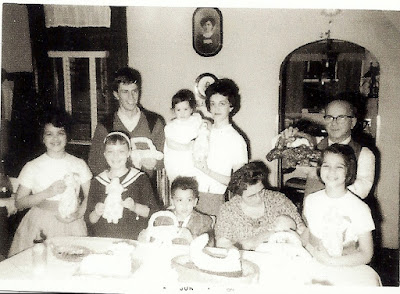 |
From the 60s: holding up Easter treats: front row is Susan
Severini, Debbie Kowinski, Tom Severini, G. holding
Steve Severini, Shirley Severini. Back: me, Rose Severini
holding Nancy Severini, Ignazio Severini. |
The extended family gathered here for holiday meals—
especially Christmas Eve and Easter—or because Aunt Toni and her family were
visiting from Maryland, or for no particular occasion other than grandma
decided it was time to eat together.
The menu for the big family meals did not vary much. They began with a version of what is
elsewhere called wedding soup, though I never heard it called anything in
particular there in Youngwood. It was a clear soup, with very small round
meatballs and a lot of escarole.
At the beginning of
the holiday meals there would be various seafood dishes, which I never heard
called appetizers, but I suppose they were.
These varied from calimari
(squid) to a variety of fish in various forms. My favorite was the breaded
smelts, tiny and tasty. These seafood
dishes were especially plentiful for the Christmas Eve “vigil” meal, which was
meatless.
Next was the pasta course.
This could be spaghetti or any of its variants, or ravioli stuffed with
meat and ricotta cheese, or the pasta with beans known as pasta e fagioli and
pronounced “pasta fazool.” It is not to be confused with the soup version. I
For these meals, my grandmother made the pasta from
scratch. Most often it was spaghetti, which I've come to believe was usually
spaghetti alla chitarra, a thicker spaghetti with a square shape (named after the guitar string-like kitchen tool that gives it is thick cut.) It is a cut that originated in the Abruzzi.
For less formal meals, she
might use spaghetti from the blue and white Mueller’s box. But on all occasions, the sauce was her
homemade sauce—and the exact recipe was a secret.
As for where the food came from, the Bizub butcher shop next
door was still operating in the late forties, but I’m not sure how long it
lasted into the fifties, if at all.
There were a few grocery stores within walking distance of 200 Depot,
but some Italian items might have been less accessible. I seem to recall that good olive oil was
prized (and probably expensive).
 |
| the DeLallos |
Fortunately in the 1950s, the De Lallo Italian market opened
on Route 30 west of Greensburg near Jeannette.
My grandmother shopped there when she could.
There was Italian bread, sliced and unsliced, available in
white paper bags. I recall unsliced
loaves of bread from the St. Vincent bakery, which my grandmother venerated but
which seemed awfully hard to eat.
If this was a Christmas Eve dinner, the menu was meatless,
so the spaghetti would be served with tuna in the sauce instead of meat.
Otherwise, it was usually a red meat sauce (though some dishes, like pasta
fazool, might have a colorless sauce.)
During the spaghetti course, a boat of extra sauce and a plate of
meatballs and other meats (some in sauce, some not) including veal cutlets
would be passed around, then left on the table.
Eventually, after being exhorted to take seconds and thirds
(refusing them would elicit my grandmother’s pained cry, “You no like?”), there
would arrive the meat course: usually roasted chicken. The chicken would often come with small
roasted potatoes and carrots. A large
salad would appear at the same time. I
liked the combination of chicken and salad.
With the meal, the adults would drink red wine and the children
7-Up. Ginger ale would also be
available. Everybody also had a tumbler
of water.
The dessert might be deferred until later, but invariably
and inexplicably, my grandmother ended the main meal with Jell-O gelatin. Jell-O was ubiquitous in the 1950s—that and
puddings similarly prepared from an individual little box. They were standard desserts at home, but
seemed a little incongruous at the end of this huge Italian meal. Often there was a ritual in which diners
would groan when my grandmother brought on the jell-O, since everyone was
already stuffed. Nevertheless, she
would act affronted.
After dinner, trays of nuts (and a nutcracker) would appear
on the dining room table, perhaps with some Stella Doro anisette toast and
assorted cookies. At Christmastime,
there would be the Torrone nougats in tiny cardboard boxes, wrapped in silver
paper and then a very thin layer of transparent paper.
For Easter, my grandmother made cake-like pastries, to which
she added icing and candy sprinkles.
The “boys” got these in the shape of horses, the “girls” in the shape of
dolls. There was also a dessert cake in
the shape of a lamb, covered with coconut vanilla icing.
At a certain point, for family dinners I got a designated
seat at the far left end of the table on the fireplace side, next to my
grandfather, who was always at the head of the table there. (My grandmother was at the other head of the
table, more accessible to the kitchen.)
I was placed there mostly because I was left handed, but there was a
certain recognition of me as the senior grandchild. The adults drank wine from
small tumblers, and generally the children had the same size tumblers for their
7-Up. My grandfather began spiking my
ginger ale with a little red wine. The
proportion of wine to ginger ale increased as I got older, until I was deemed
ready to have a full glass of wine with my meal.
 |
After dinner I liked to light up a Lucky. Not really.
My stuffed dog didn't approve. (Note the refrigerator in 1947.) |
My grandparents Ignazio and Gioconda usually spoke Italian
to each other, and sometimes with their children: Flora, Antoinette and
Carl. Although my mother noted in a
“baby book” that at age 2 I spoke both English and Italian, I probably was
mostly repeating words and phrases. (At around that age, I was told, at
Youngwood gatherings I stood up on the coffee table while Italian relatives and
friends fired questions at me in Italian, and I came back with smart answers,
and everybody laughed.)
However, if I ever had the ability to converse in Italian, I
soon lost it. But there were times when
my mother and grandmother switched to Italian, sometimes because they didn’t
want the children to understand what they were saying. Sometimes I realized this, so of course I
listened harder, while pretending I didn’t care. If Aunt Toni or Uncle Carl were also involved in the
conversation, and they were all speaking Italian, then I listened for names to
at least figure out who they were talking about.
I remember one or two often repeated idioms ( when we whined we often heard: Poveta te! Na vous fa! which my mother translated as "You poor thing you--what are we going to do?") and a few words that erupt from somewhere in my memory (Aspetta! or simply aspett! which means "wait" or "just a minute.")
After dinner, the women gathered in the kitchen to wash
dishes and put things away, while the men repaired to the living room, and
usually napped. The kids had to fend
for themselves for awhile.
Later there might be card
games: the kids might play Old Maid at the dining room table, or a regular deck
would be used for a simple game like hearts, played by adults and older
children. These games could be in the
dining room or at the kitchen table. Eventually the adults had coffee and usually there was
dessert. I mostly recall sponge cake,
and the occasional angel food cake.
The dinner table got more crowded over the years. My sister
Kathy was born in 1950, my sister Debbie in 1954. Antoinette and Bill Wheatley’s first son Richard (Dicky) was born
in 1949, their second, William (Billy), in 1954, and their third, Robert
(Bobby), in 1956. They were
occasionally in Youngwood for one holiday or another, but they usually visited
in the summer, and their presence was reason enough for a family dinner.
When I was around 7, I saw a tall pretty young woman with my
Uncle Carl at the house on Depot St.
Once I ambled into the living room and saw them sitting on my
grandfather’s chair—both of them at once!
Her name was Rose.
 |
| Rose and Carl. Kathy and Flora among those looking on. |
And then it was Aunt Rosie.
Carl Severini married Rose Morozowich on June 12, 1954. Their wedding reception was held at the Roof
Garden of the Penn Albert Hotel, an event I remember. There was a live band—possibly the first such band I’d ever seen
or heard—and a lot of people, talking, laughing and dancing. The band played popular tunes and the
Italian dances. It was very exciting.
My mother Flora took
a hand in keeping the reception running smoothly, and at one point asked me to
help her collect used glasses from the tables and take them back to the kitchen
for washing. I loved it. I could dash around the room, a boy on a
mission. At another wedding reception
or similar affair that year, I started collecting glasses again, but my mother
told me this wasn’t our family’s party and I didn’t need to do it. I thought it was my regular job.
 |
Back: Bobby Wheatley with Ignazio; Shirley Severini,
Billy Wheatley, Susan Severini, Kathy Kowinski. Front:
Dick Wheatley and me. |
So throughout the 1950s and early 1960s the dinner table at
Youngwood got even more crowded with the addition of Carl and Rose’s children:
Susan, Shirley, Nancy, Tom and Steve.
Apart from limited elbow room, I noticed that the olives had disappeared
from the salad by the time it got to me—the Severini girls and probably my
sisters were olive fanatics. It was
okay with me, I didn’t much like olives at the time.
There were so many children that my grandmother attached strings
to napkins so they could be tied around young necks, to protect their holiday
frocks and white shirts from spaghetti sauce.
Eventually a children’s table was added. I would occasionally give up my usual spot (or be persuaded to)
and preside over the children’s table, and keep everybody laughing.
Eventually there were new spouses of my generation and then
children of another generation who might remember this dining room and these
meals.
200 Depot St. Memories: Downstairs, Upstairs
In the far corner alcove of the dining room of my Severini
grandparents home was the door down to the
basement, or as it was usually called, the cellar. These were tricky stairs, though the steps had solid backs (open
backs that seem big enough to fall through become something that a child is
very aware of) and a banister. Along the stairs or nearby were bottles of the
only soft drink besides ginger ale I can remember ever being served at 200
Depot St.: 7-Up.
At the bottom of the stairs was a table, and next to it a
stove with an oven. There was a big table in the center of the room, probably
an old kitchen or dining room table, and some chairs. There was a row of large dark wood cabinets, with glass jars in
them—either empty, or holding “canned” fruit or tomatoes from the garden. The floors were mostly cement, though with a
little scraps of linoleum here and there.
Those extended family meals often began down there. The tiny
kitchen was inadequate for preparing these elaborate feasts. Much of the work was done in the cellar.
I remember more than once watching my grandmother roll out
the pasta and dust it with flour on that small table at the foot of the stairs.
It was probably down there that the cheese was grated by hand from large hard
chunks. Probably the chicken was roasted in this cellar oven.
 |
| pizelles, of my own making |
Before Christmases, the bigger table in the center of the
room might be crowded with pizelles, which in the early 50s were baked in a
black pizelle iron on the flame of the gas stove. Some pizelles were paired,
with a dark fig paste filling between them. Pizelles typically had anise
flavoring, but perhaps also almond or vanilla. I’m not sure if my grandmother
baked the jumbalones in the cellar oven, except perhaps larger quantities for
holidays. Her jumbalone cookies were
large figure 8s, a shape I’ve never mastered.
This was one of three “rooms” in the cellar. Walking across this room from the stairs, to
the right there was about a cement step up of about a foot to another
room. A light switch at the top of the
stairs turned overhead lights in that first room but this other room was dark,
lit by one or two overhead bulbs, turned on and off with a pull chain. The floor was bare cement, the walls were
clammy bare concrete and stone.
 |
| 1950s washer |
In it was the
ringer washing machine, wash tubs, a makeshift shower, and the furnace. There was an area partially enclosed by wood
that in these years contained the coal that heated the furnace. I can vaguely remember seeing the coal chute
along the narrow sidewalk between the house and the house next door (the
Shoaf’s), dispensing coal through a cellar window.
On the other side of the central table, through a door was a
half-inside, half-outside area where gardening tools were kept. There was an
old push mower for the tiny back lawn. Through another door—a rickety old
screen door in the summer—there were some damp cement steps leading up to a
sidewalk (part brick, part cement) and the back yard.
For some years there was a cat--as I recall, a white cat with some black markings--that I'd briefly see coming up the cellar stairs or outside. The cat was functional: to catch mice, but it was fed, too. My grandfather would sometimes say that he was making spaghetti for the cat, which my grandmother didn't exactly buy.
The 200 Depot Street house had a second floor and an attic. Entering
the house from the front door, down that narrow hallway, the stairs to the
“upstairs” were directly ahead. Facing
these steps, on the wall to the right there were four buttons-- two horizontal
rows and two vertical-- that controlled the first floor hall lights, and the
lights on the second floor that illuminated the stairs. If you depressed one button, the one below
or above it would pop out. I can’t
count the number of times I pressed those buttons, but I never really
remembered which ones controlled the hall lights and which ones the upstairs.
At the top of the partially carpeted steps with the banister
attached to the wall, you would be facing a window overlooking the back yard
and beyond. If you turned completely around, as if going back down the stairs,
there would be a long carpeted hallway just to your left, paralleling the
stairs. As you walk down the hallway
you pass three rooms to your left, with the bathroom directly in front of you
at the end of the hall.
The first room, just at the near corner, was Carl’s
bedroom. Next, the middle room had been
the bedroom shared by Flora and Antoinette.
The third room, at the opposite corner, was my grandparents’ bedroom.
In addition to frequently visiting this house with my
parents and then also my sisters, I stayed here overnight, and a few times for
more than one night. Early on, the
overnight stays were with my parents, but later I stayed there on my own. I remember sleeping in the middle room on a
summer night, listening to the frogs in the swamp across the railroad
tracks.
That room that Flora and Ant shared seemed small for two
people. There was a brass double bed, a
rocking chair and a large dark wood dresser with attached, adjustable mirror of
odd shape, sort of like a smile. Once I
woke up in that bed, convinced that the mirror had detached itself and floated
above me. I ran downstairs in
terror. My Aunt Toni looked alarmed,
and though she said it couldn’t have happened, she came up and threw a blanket
over the mirror so I could go back to sleep.

Carl Severini graduated from Youngwood High in 1948, when I
was two. He then attended St. Vincent
College, and wasn’t around much. I was
always interested in what he was doing.
My Uncle Carl was pretty much my first living hero. He was taller than anyone I knew. He played basketball with neighborhood
friends a few blocks away on First Street.
I seem to remember watching them once.
I also seem to remember that he was having problems with his eyeglasses
falling off, so my grandfather attached an elastic band to a pair. I also remember this as a plot point in the
television show “I Remember Mama.”
So I was fascinated with Carl’s bedroom, and eventually I
got to sleep there. The walls were
painted yellow, and so when my mother asked me what color I would like my
bedroom painted, and mentioned that Carl’s was yellow, I of course chose
yellow.
At the end of the hallway was the bathroom, with a big
bathtub to the right and the toilet, and on the left wall was the sink, next to
a tall covered radiator.
I remember watching my grandfather shave in the morning in
that bathroom. It may be the only time
I saw him not in a white shirt, but just a white undershirt. At that time there was a leather strap
attached to the wall next to the sink, because he shaved with a straight
razor. (Later he switched to an
electric shaver.) I absorbed the ritual
nature of shaving. A bar of shaving
soap was in a kind of bowl. It was
lathered up and applied to the face with a shaving brush. The washbasin was filled with water, stopped
with the plug, and the razor rinsed in it during the shave. Excess soap was wiped off with a towel, and
the aftershave applied.
For a long time I didn’t know that the small dark lacquered
door just outside Carl’s room led anywhere.
But then I saw it open once, and looked to see stairs leading upward. I
crept up the first few steps to see another world—the attic!
I wasn’t allowed to go up those narrow creaky stairs to the
attic for a long time. But eventually I
did explore a little of what was stored there. It was a magic attic in the way
that attics were: storehouses of treasures from the past. The most impressive
object I remember was the old gramophone, possibly from the 1920s. Like the radios and phonographs of that
era—as well as some early TVs—this was an impressive piece of furniture. I remember it as quite large. It had a crank
on the side, as I recall. I also found
some old piano rolls, and the mechanism that played them when it was inside the
piano in the living room.
Of particular interest to me were the trunks of books, that
my grandmother let me raid. That
science fiction anthology was in one of them.
Some were college textbooks, including one or two English literature
anthologies that I took and used in high school, and that I still have. Among the others were the “boys books” that
had been Carl’s, like Tom Swift and
Bob Dexter and the Radio Mystery.
Many years later I returned one of these books to Carl, at
one of the last family gatherings where I was present. It was the only one of those books I had
with his name written in it, and when he saw the handwriting, he knew
immediately it was Flora’s—it had been her gift to him. It was one of the Tom Swift books. Carl then told me that during his travels as
patent attorney for PPG, he’d collected Tom Swift editions, until he had the
entire set, and then sold them all.